
COP9 Outline Disclosure: What to Include, What to Hold for the Full Report
The outline disclosure you submit within 60 days of accepting HMRC’s offer of the Contractual Disclosure Facility (CDF) needs to describe what you did, how you did it, roughly when it happened, and which taxes were affected, but it does not need exact figures or supporting evidence at this stage. HMRC’s own Code of Practice 9 (COP9) confirms the outline disclosure is your first, summary-level admission of deliberate behaviour, with the detailed calculations, workings, and evidence reserved for the full disclosure report commissioned afterward, typically within six months.
This distinction between what belongs in the outline and what waits for the full report is where I see people cause themselves the most avoidable difficulty. Some clients arrive at the outline disclosure stage trying to produce a forensic, fully quantified account within days of receiving a genuinely frightening letter, which is unnecessary and often produces figures that turn out to be wrong once proper records are examined. Others go the opposite way, giving a vague, incomplete summary that misses matters they genuinely intended to include, which creates a far more serious problem: the immunity from prosecution HMRC offers under the CDF only ever covers what you actually disclose.
What COP9 and the CDF Actually Offer
COP9 is issued where HMRC has information giving it reason to suspect deliberate tax fraud, and it will not normally tell you what that suspicion relates to. Rather than opening a criminal investigation immediately, HMRC offers the CDF, a contractual arrangement under which you commit to making a complete, accurate, open, and honest disclosure of all deliberate behaviour, and all other irregularities, including careless or innocent errors, in exchange for HMRC’s commitment not to pursue a criminal investigation into the matters you disclose. Civil penalties, interest, and repayment of the tax itself still apply, and HMRC’s own guidance is explicit that the Commissioners retain the right to commence a criminal investigation if you accept the CDF and then fail to make a complete, accurate, and honest disclosure, or if you provide materially false or misleading information at any stage.
COP9 Outline Disclosure:
What to Include vs What to Hold
Navigating HMRC’s Contractual Disclosure Facility (CDF): Master the vital line between the 60-day outline and the 6-month full forensic report.
Stage 1 (60 Days) vs Stage 2 (~6 Months) Comparison
Avoid premature forensic calculations or fatal material omissions. Click any item card to reveal strategic practical advice.
Outline Disclosure (CDF)
Focus: Scope & Admission. Honest overview of all deliberate irregularities. Approximate parameters are fully acceptable.
What Happened (Nature of Irregularity)
Undeclared turnover, cash wages paid, false expenses claimed, or unrecorded sales.
How It Was Done (The Modus Operandi)
Secondary undisclosed bank accounts, parallel cash books, or fictitious invoices.
Rough Timing & Estimated Scale
Approximate tax years (e.g. 2018/19 to 2023/24) and broad bands (e.g. ~£20k/yr).
All Taxes Affected & Other Errors
Identify Income Tax, Corporation Tax, VAT, PAYE/NICs, plus innocent/careless mistakes.
Full Disclosure Report
Focus: Forensic Quantification & Proof. Commissioned after HMRC accepts the outline and agrees the scoping terms.
Exact Reconciled Computations
Year-by-year, transaction-by-transaction tax lost calculations.
Supporting Evidence & Bank Ledgers
Complete primary vouchers, contracts, full bank statements, and invoices.
Assumptions & Estimation Methodologies
Reasoned models for lost records (e.g. gross profit margin reconstruction).
Interest & Schedule 24 Penalty Mitigation
Formal computations of interest and submissions on ‘telling, helping and giving access’.
Acceptable HMRC Outline Disclosure Example
“Between tax years 2019/20 and 2024/25, unrecorded cash takings of approximately £15,000 to £25,000 per year were retained from business revenue and omitted from Income Tax & VAT returns, deposited into an undeclared secondary account.”
→ Notice: No formal invoices or penny-level sums attached. This successfully fulfills HMRC’s 60-day outline requirement while safeguarding criminal immunity!
COP9 Outline Preparation Checklist
Track your procedural tasks during the crucial 60-day window
The 60-Day Clock: What Happens If You Miss It
HMRC’s guidance on the CDF process confirms the 60-day period runs from the date you receive the CDF letter, and this deadline can only be extended in genuinely exceptional circumstances, requiring a written request. If HMRC does not hear from you within the 60 days, either accepting or rejecting the offer, it treats this as a decision not to cooperate, and proceeds to open either a civil or criminal investigation into the suspected fraud without the protection the CDF would otherwise have offered. This is not a deadline to treat casually or let drift while you decide what to do. Seeking specialist advice the moment a COP9 letter arrives, rather than partway through the 60-day window, is the single most important practical step available to you at this stage.
What Must Go Into the Outline Disclosure
The outline disclosure exists to give HMRC a genuine, honest picture of every area where deliberate behaviour has occurred, described at a level of detail sufficient for HMRC to understand the scope and nature of what happened, without requiring the fully quantified analysis that only comes later. In practice, this means covering four things for every deliberate matter you are aware of: what actually happened, whether that is income left out of a return, cash sales not recorded, or expenses claimed that were never genuinely incurred; how it was done, for example through use of an undeclared bank account, maintaining two sets of records, or routing income through a connected entity; roughly when it happened, covering the years or periods involved even where you cannot pin down exact dates; and which taxes are affected, whether Income Tax, VAT, Corporation Tax, or another tax or duty HMRC administers.
Where you can reasonably estimate the scale involved, even in broad terms, small, moderate, or substantial, rather than a specific figure, including that estimate strengthens the disclosure and helps HMRC understand what it is dealing with. What the outline disclosure does not require is a fully reconciled set of figures, supporting documents, or a formal computation of the tax at stake. HMRC’s own guidance is explicit that exact figures are not usually necessary within the 60-day window if they cannot reasonably be obtained in that time, provided the disclosure is honest and covers everything you can remember.
Why “Approximate” Is Genuinely Acceptable Here
This is worth stating plainly because it is where I see clients cause themselves unnecessary stress. Sixty days is rarely enough time to properly reconstruct years, sometimes decades, of financial records to a level of precision that would satisfy an accountant preparing a final report. HMRC does not expect that at the outline stage. What it expects is completeness and honesty about the categories and nature of what went wrong, not mathematical precision about the amounts involved. A disclosure that says “unrecorded cash takings from the business, roughly £15,000 to £25,000 a year, across approximately six tax years from 2019/20 onward, relating to Income Tax” is a genuinely adequate outline disclosure. Spending the entire 60-day window trying to arrive at a single, precisely reconciled figure before submitting anything at all is not necessary, and risks the far more serious outcome of missing the deadline altogether.
What Should Wait for the Full Disclosure Report
Once HMRC accepts your outline disclosure, an opening meeting is arranged with you and your adviser present, followed by a scoping meeting that establishes the full extent of what HMRC expects the disclosure report to cover. You are then commissioned to prepare a full disclosure report, typically within around six months, which is where the detailed work genuinely belongs: reconstructed figures for each tax year and tax type affected, the methodology and assumptions used to arrive at those figures where records are incomplete, supporting evidence, bank statements, invoices, third-party records, and a formal computation of the resulting tax, interest, and any penalty position. HMRC’s own guidance acknowledges that in many cases there is simply not enough surviving documentary evidence to establish figures with total precision, and that reasonable assumptions and estimates, properly explained and justified, form a normal and expected part of the report, which HMRC will then review and test before negotiating a final settlement.
Front-loading this level of detail into the outline disclosure, beyond what is genuinely known and readily available, adds no protective value and often introduces errors that then need correcting later, undermining confidence in the eventual report. The outline disclosure’s job is to establish the scope of what needs investigating. The full disclosure report’s job is to establish, as accurately as the available evidence allows, exactly how much.
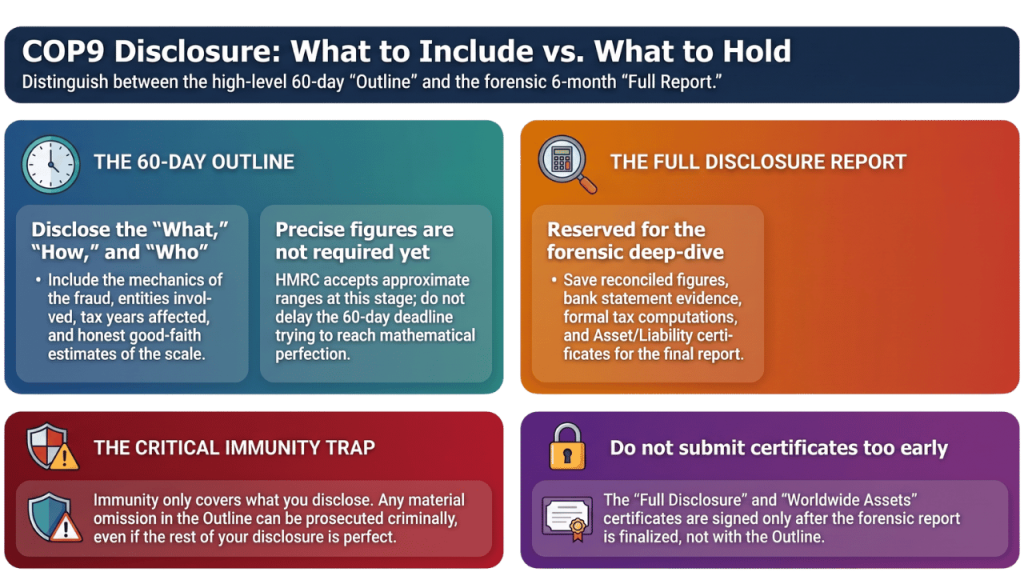
The Single Biggest Risk: Material Omission
This is the point I return to with every client going through this process, because it is the one genuine trap in an otherwise procedurally structured system. The immunity from criminal prosecution the CDF provides only ever extends to the specific deliberate behaviour you actually disclose. If a material matter is left out of the outline disclosure, whether through a genuine oversight, a deliberate decision to hold something back, or simply forgetting something that happened years earlier, HMRC reserves the right to pursue a criminal investigation specifically in relation to that omitted matter, regardless of how complete and honest the rest of your disclosure was.
This is precisely why the outline disclosure needs to cast a genuinely wide net across everything you can recall, even matters that feel minor, ambiguous, or from many years ago, rather than a narrow account focused only on the issue you suspect prompted the COP9 letter in the first place. HMRC often already knows more than it reveals in its opening letter, and a disclosure that conveniently covers only the areas HMRC appears to already suspect, while omitting a separate issue you were hoping might go unnoticed, is the exact scenario that converts a manageable civil settlement into a genuinely serious criminal exposure.
Penalties: Why the Quality of the Outline Disclosure Still Matters
Even within the civil route the CDF preserves, the level of penalty ultimately charged depends heavily on the quality and timing of cooperation, and this starts with the outline disclosure itself, not just the eventual full report. Where deliberate behaviour has occurred, HMRC’s penalty regime under Schedule 24 of the Finance Act 2007 applies a minimum penalty that is meaningfully lower where a disclosure is unprompted, made before HMRC has any reason to suspect the specific matter, rather than prompted, made only once HMRC has already indicated it suspects wrongdoing. HMRC’s own factsheet on penalties for inaccuracies sets out how these behaviour-based percentages are calculated, and a proactive, comprehensive outline disclosure, covering everything upfront rather than emerging piecemeal as HMRC’s questions probe further, consistently produces a more favourable penalty outcome than one that reads as grudging or incomplete.
Because deliberate behaviour also opens an assessment window of up to 20 years, rather than the four or six years that apply to careless or innocent errors, the financial stakes of getting the scope of the outline disclosure right, covering every affected year rather than a partial selection, are considerably higher here than in an ordinary compliance check. Where the eventual tax lost is significant and the disclosure was prompted rather than unprompted, HMRC may also publish your details as a deliberate defaulter under its criteria for publishing deliberate tax defaulters, a further consequence that a genuinely complete, cooperative disclosure can help avoid or reduce.
If You Have Nothing Deliberate to Disclose
Not every COP9 letter reflects genuine deliberate wrongdoing, and HMRC’s own guidance recognises that it keeps an open mind to the possibility of an innocent explanation. Where, after careful and honest reflection with your adviser, you genuinely believe there has been no deliberate behaviour, the correct response is to reject the CDF offer rather than making a false admission simply to secure the immunity it provides. HMRC takes a notably dim view of anyone who makes an initial admission of deliberate wrongdoing purely to obtain the CDF’s protection and then attempts to withdraw or soften that admission later in the process. Rejecting the CDF does not mean refusing to engage; you should still offer full cooperation with whatever investigation follows, since your ongoing conduct and level of cooperation continues to matter regardless of which route you take.
Scotland and Wales: One Process Across the UK
COP9 and the Contractual Disclosure Facility are administered UK-wide by HMRC’s Fraud Investigation Service, and the civil process itself, the 60-day window, the outline disclosure requirements, and the structure of the eventual disclosure report, applies identically regardless of where in the UK you are based. The one genuine difference worth understanding concerns what happens if a case is not resolved through the civil route and a prosecution ultimately proceeds. In Scotland, criminal prosecutions are brought by the Crown Office and Procurator Fiscal Service rather than the Crown Prosecution Service that handles equivalent cases in England and Wales, operating under Scots criminal procedure rather than the procedure that applies south of the border. This distinction is relevant only if the civil route breaks down entirely; the COP9 and CDF process itself, and the advice on what belongs in an outline disclosure, is exactly the same whether you are based in Scotland, Wales, or elsewhere in the UK.
Practical Steps Worth Taking
- Seek specialist advice the moment a COP9 letter arrives, not partway through the 60-day window, since the decisions made early shape the entire course of the investigation.
- Cast the outline disclosure as widely as possible across everything you can genuinely recall, rather than narrowing it to the specific issue you suspect triggered HMRC’s interest.
- Use approximate figures and date ranges where exact records are not readily available, since HMRC’s own guidance accepts this is normal and does not require precision within the 60-day window.
- Reserve detailed computations, reconstructed figures, and supporting evidence for the full disclosure report commissioned after the outline disclosure is accepted, rather than trying to compress that work into the initial 60 days.
- If, after honest reflection, no deliberate behaviour has genuinely occurred, reject the CDF rather than making a false admission, while still offering full cooperation with whatever process follows.
Key Takeaways
The outline disclosure and the full disclosure report serve genuinely different purposes, and understanding that distinction is what allows the 60-day window to be used properly rather than treated as an impossible deadline for producing a finished set of accounts. Completeness of scope matters more than precision of figures at the outline stage, and the single greatest risk in the entire process is not an inaccurate estimate corrected later, but a genuine matter left out entirely, since the protection the CDF offers only ever covers what you actually tell HMRC about.
Frequently Asked Questions
What exactly needs to be included in a COP9 outline disclosure?
A summary of what happened, how it was done, the approximate years or periods involved, which taxes are affected, and a rough estimate of scale if you can provide one. Exact figures and supporting evidence are not required at this stage.
How long do I have to submit an outline disclosure after receiving a COP9 letter?
60 calendar days from the date you receive the Contractual Disclosure Facility offer, a deadline that can only be extended in genuinely exceptional circumstances confirmed in writing by HMRC.
Do I need exact figures in my outline disclosure?
No. HMRC’s own guidance confirms exact figures are not usually necessary within the 60-day window if they cannot reasonably be obtained in that time, provided the disclosure is honest and covers everything you can remember.
What happens if I forget to mention something in my outline disclosure?
The immunity from prosecution the CDF provides only covers matters you actually disclose. A material omission, whether accidental or deliberate, can leave you exposed to a criminal investigation specifically in relation to that omitted matter, even where the rest of your disclosure was complete and honest.
What comes after the outline disclosure is accepted?
An opening meeting with HMRC and your adviser, followed by a scoping meeting establishing the full extent of the investigation, after which you are commissioned to prepare a full disclosure report, typically within around six months, containing detailed figures and supporting evidence.
Can I use estimates in the full disclosure report if I don’t have complete records?
Yes. HMRC’s guidance acknowledges that sufficient documentary evidence is often unavailable, and reasonable, properly explained assumptions and estimates are a normal and expected part of the report, which HMRC then reviews and tests before agreeing a final settlement.
What if HMRC’s letter doesn’t actually apply to me because I haven’t done anything deliberately wrong?
You can reject the offer of the Contractual Disclosure Facility, but you should still offer full cooperation with whatever investigation follows. Making a false admission of deliberate behaviour purely to secure the CDF’s protection, and then trying to withdraw it later, is treated very seriously by HMRC.
How far back can HMRC go if deliberate behaviour is admitted?
Up to 20 years, considerably longer than the four or six-year assessment windows that apply to careless or genuinely innocent errors, which is precisely why the outline disclosure needs to cover every affected year rather than a partial selection.
Is the COP9 process different in Scotland?
The civil COP9 and CDF process itself is identical UK-wide, administered by HMRC’s Fraud Investigation Service. The only genuine difference arises if a case proceeds to prosecution, where Scotland’s Crown Office and Procurator Fiscal Service, rather than the Crown Prosecution Service, handles matters under separate Scots criminal procedure.
Disclaimer
The information published by Total Tax Accountants is provided for general guidance only and should not be regarded as professional, financial, tax, or legal advice. Although every effort is made to ensure that the content is accurate, current, and reliable, Total Tax Accountants makes no representations or warranties—express or implied—about the completeness, accuracy, suitability, or availability of any information, services, products, or graphical content contained within these articles. Any reliance placed on such information is strictly at your own risk. Please note that charts, statistics, and graphical data may not always be fully precise or reflect the latest HMRC updates.
Tax and accounting legislation in the UK changes regularly, and individual circumstances can significantly affect the correct interpretation of the rules. Readers are therefore strongly encouraged to seek personalised advice from a qualified professional before taking any action based on the information provided.
Total Tax Accountants accepts no liability for any errors, omissions, or inaccuracies in the content, nor for any losses, damages, or adverse consequences arising from the use or interpretation of this information.